A Bait-Fishing Crow
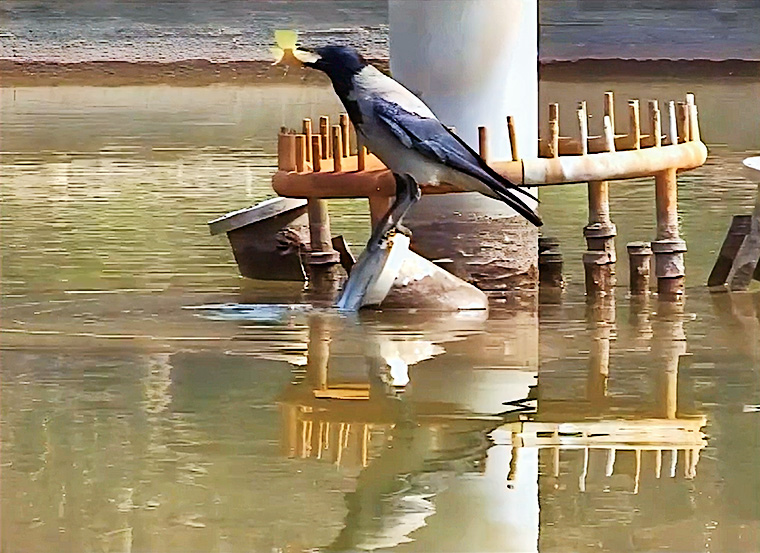
In March 2000, in a park in Ramat Gan, Israel, I discovered a hooded crow (Corvus cornix) using bread as bait to catch fish.
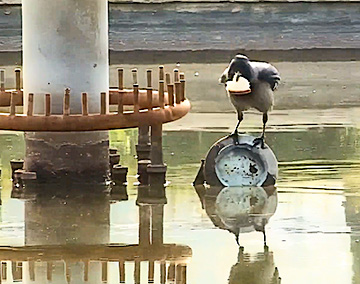
The crow arrived at a small circular pool with a piece of bread it had found in the park, landed on a post just above the water, and began dropping crumbs into the pool. Crows often dip bread to soften it. This crow, however, seemed to be directing much of its attention to whatever was moving under the surface of the water. I stayed, and about an hour and a half later it returned, again with bread – and this time it struck and caught a fish!
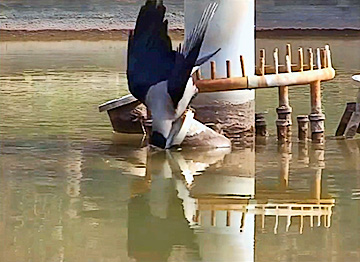
Over the following weeks I returned several times and spread bread across the park to see whether other crows would carry it elsewhere. They did not; they ate the fresh bread on the spot. Only at this one pool, from this one perch, did the behavior reappear. The crow – almost certainly a single individual, probably a male nesting just above the pool – behaved unlike any other bird in the park.
Altogether I observed about ten occasions on which he brought bread to this perch, and on four of them he caught a fish. Once I photographed a catch on slide film, using an SLR from a distance. On April 5th, 2000, I left a rented video camera running on a tripod by the pool and recorded one successful and a few unsuccessful attempts. The original footage of the successful catch, about a minute long, has been on YouTube for over fifteen years; by 2025 it had more than 290,000 views.
In 2025 I made a longer narrated film recounting the serendipitous personal story behind the discovery and exploring what may have made this crow so successful. You can watch it on YouTube.
Bait-fishing – actively placing bait on the water to draw fish within striking range – is documented in roughly a dozen to seventeen bird species, almost all herons, with a few scattered records elsewhere (Ruxton and Hansell 2011; Jelbert 2017). Among corvids it is otherwise unrecorded: this hooded crow is, to my knowledge, the only documented case. Crows and ravens do rob anglers' lines and steal bait from hooks – but that is theft, not bait-fishing.
Crows are among the smartest species on Earth, but there are other clever birds and mammals, and I will not review bird intelligence here. However, what I may be trying to do here is answer my own question: what was it that enabled this particular crow to learn such a unique skill?
The answer seems to be a rare combination of conditions and opportunities: a pool that was clear and deep, with a perch set directly above the water at just the height a crow can strike from, and perhaps also the fact that it lay right below his nesting tree. He almost certainly began by softening bread – a common sight in the park – and noticed fish rising for the crumbs, which is also how biologists believe active bait-fishing originates in herons (Ruxton and Hansell 2011). The behavior ended when the pool was emptied, two or three years later, perhaps earlier. This footage may be the only record of a corvid fishing with bait.
Cite as: Hasson, O. 2000. Bait-fishing by a hooded crow (Corvus cornix), Ramat Gan, Israel (observed March–April 2000). orenhasson.com/EN/bait-fishing.htm
References
Higuchi, H. 1986. Bait-fishing by the green-backed heron Butorides striata in Japan. Ibis 128: 285–290.
Ruxton, G. D. & Hansell, M. H. 2011. Fishing with a bait or lure: a brief review of the cognitive issues. Ethology 117: 1–9.
Jelbert, S. 2017. Bait fishing. In: Shackelford & Weekes-Shackelford (eds), Encyclopedia of Evolutionary Psychological Science. Springer.